
Insights & Practice
The Body Speaks to the Brain: Why Mental State Is Not Just a Matter of Thought
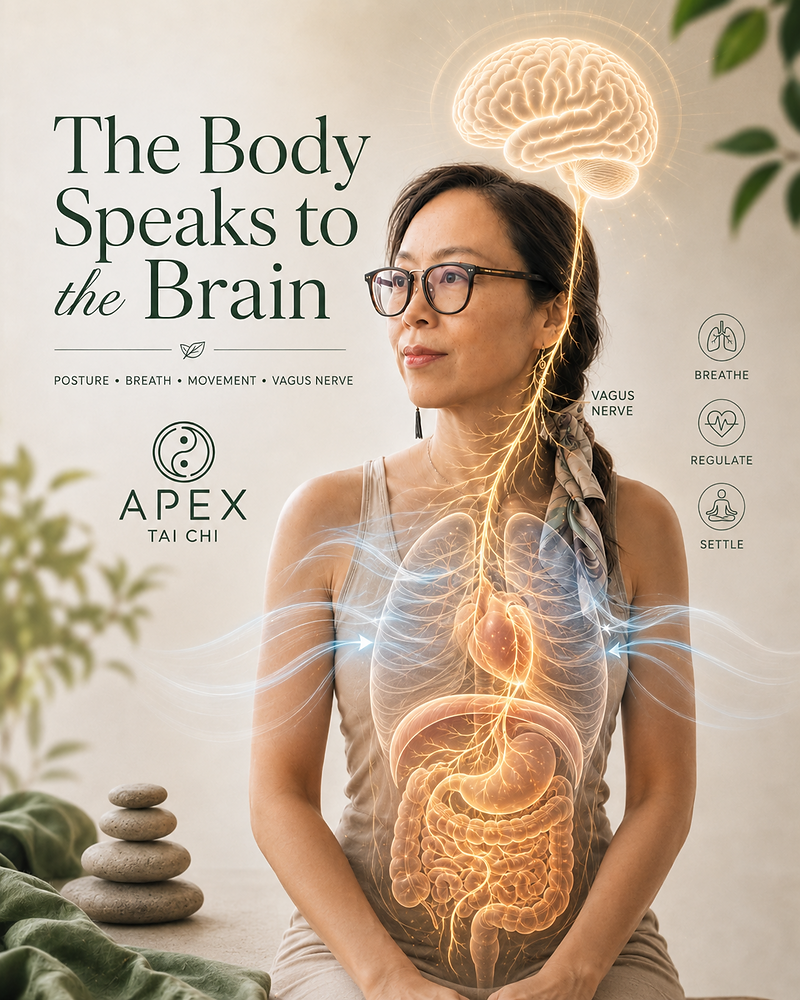
How posture, breathing, tension and movement can influence how settled, clear and focused we feel.
Dr Jar - Apex Tai Chi - Swansea, South Wales & Online
When the mind feels overloaded, our instinct is often to add more thought.
We analyse the problem. We make another list. We tell ourselves to calm down.
But thinking does not happen in isolation.
It happens in a body that may be tense, breathing shallowly, sitting for hours or moving through the day in a state of constant physical readiness.
That matters, because the relationship between body and mind works in both directions.
The body is part of the mental picture
We often talk about stress, concentration and mental clarity as though they belong entirely to the brain.
Yet every thought takes place within a physical state.
The way we are standing or sitting, how freely we are breathing, how much muscular tension we are carrying and whether we have moved at all during the day all form part of that state.
Research across posture, breathing, movement and mind-body practices suggests that physical and psychological states can influence one another, although the size and nature of those effects vary considerably.
For Tai Chi, this idea is hardly unfamiliar.
The practice has always involved the coordination of posture, breathing, attention and movement rather than treating mind and body as separate departments.
The body is not simply carrying the brain around
Consider what happens during a demanding day.
You may spend several hours at a screen.
The shoulders gradually rise.
The jaw tightens.
Breathing becomes smaller.
Movement becomes limited.
Attention narrows around whatever needs to be solved next.
None of these things necessarily means something is medically wrong. They are ordinary physical responses to concentration, pressure and habit.
But once established, the physical pattern itself can become part of how the moment feels.
Trying to tell yourself to “relax” while still gripping the chair, holding the breath and staring at another notification is therefore asking thought to do all the work.
Sometimes changing the physical conditions is more useful.
Posture changes the conditions for movement and breathing
Posture is often misunderstood as a question of whether we are sitting or standing “correctly”.
Tai Chi takes a more useful approach.
Rather than forcing the body into an ideal pose, we ask whether the structure is organised well enough for unnecessary effort to reduce.
Can the head remain naturally supported?
Can the shoulders release without collapsing?
Can the weight travel through the legs into the ground?
Can the spine remain upright without becoming rigid?
These changes may seem small, but they alter how the body is being used.
Research on posture suggests that posture and emotional state can influence one another, although it would be simplistic to claim that adopting one particular posture automatically produces a particular mood.
The useful point is simpler:
How we organise the body can influence how we experience being in it.
Breathing is both automatic and influenceable
Breathing occupies an unusual position.
Most of the time we do not consciously control it, yet we can deliberately alter its rhythm, depth and pace.
Stress and sustained concentration can change breathing patterns, while deliberately changing breathing can in turn influence aspects of our immediate physiological state.
That does not mean there is one magical breathing technique that switches stress off.
It means breathing provides a practical bridge between automatic bodily processes and conscious action.
Tai Chi and Qigong make use of this without requiring us to obsess over every breath.
As movement becomes slower and unnecessary tension reduces, breathing can often become easier and less restricted.
That is different from forcing the breath to become deep.
Tension is useful until it becomes unnecessary
Muscular tension is not the enemy.
We need tension to stand, walk, lift, balance and respond quickly.
The problem is unnecessary tension.
Many of us continue using effort long after the task requiring it has ended.
The shoulders remain lifted after the stressful email.
The hands stay tight after we leave the steering wheel.
The abdomen remains braced while sitting quietly.
Tai Chi repeatedly trains the ability to notice this excess effort and release what is no longer required while preserving structure.
Traditionally, this quality is closely related to Song (鬆).
Song is sometimes translated simply as “relaxation”, but that misses something important.
It does not mean becoming limp.
It means reducing unnecessary tension while remaining organised, connected and responsive.
That principle has obvious relevance well beyond a Tai Chi form.
Movement can interrupt a fixed state
When we remain physically still for long periods, the body has fewer opportunities to change state.
Walking, stretching or practising Tai Chi does something very simple but valuable:
it changes what the body is doing.
Weight shifts.
Joints move.
Breathing adapts.
Attention moves from abstract thought towards sensation and coordination.
Tai Chi adds an additional layer because movement is deliberately slow enough for us to notice how we are organising ourselves.
Research on Tai Chi has found associations with psychological wellbeing and stress-related outcomes in a range of populations, but the results vary across studies and do not justify treating Tai Chi as a universal treatment for stress or mental-health conditions.
More recent work examining brain activity is interesting, but it remains methodologically varied and often exploratory.
That means claims that Tai Chi reliably produces a particular neural state should be treated with caution.
What we can say more confidently is that Tai Chi combines several things that are highly relevant when we feel overloaded:
movement
postural organisation
breathing
balance
coordination
sensory attention
sustained focus
The combination matters.
Why Tai Chi approaches the problem differently
When we are mentally overloaded, it is tempting to treat the mind as a machine that simply needs better instructions.
Tai Chi starts somewhere else.
It asks:
How are you standing?
Where is your weight?
What are you holding unnecessarily?
Can you breathe without forcing it?
Can the movement begin from the centre rather than from accumulated tension?
These are physical questions.
Yet answering them changes the experience of the whole person.
That is part of what makes Tai Chi more than a collection of slow movements.
The practice trains us to recognise that mental state and physical state are not isolated from one another.
Sometimes clarity does not begin with another thought.
Sometimes it begins by changing the body from which we are thinking.
Explore this through practice
This week at Apex Tai Chi we are exploring The Body Speaks to the Brain through authentic Tai Chi and Qigong.
If you find it difficult to switch off, carry a great deal of tension or simply want to feel more settled and connected in your movement, this principle becomes much clearer when experienced rather than merely read about.
Book an Apex Tai Chi public session:/classes/
Booking is encouraged and appreciated. Payment can be made at the venue.
Sometimes clarity does not begin with another thought.Sometimes it begins by changing the body from which we are thinking.
Wishing you a steady week ahead, which is full of equanimity.
Dr Jar
Apex Tai Chi
References & Further Reading
Yue F, Chen N, He H, Zhang X, Pan C, Yang H. (2026). Tai Chi, brain activity and psychological outcomes: a systematic scoping review. Frontiers in Psychology.
A recent review examining Tai Chi, brain activity and psychological outcomes. It highlights promising findings while also noting substantial variation in study methods and evidence quality.
Read the study:
https://www.frontiersin.org/journals/psychology/articles/10.3389/fpsyg.2026.1865028/full
Wang C, Bannuru R, Ramel J, Kupelnick B, Scott T, Schmid CH. (2010). Tai Chi on psychological well-being: systematic review and meta-analysis. BMC Complementary and Alternative Medicine.
A systematic review examining Tai Chi in relation to stress, anxiety, mood and psychological wellbeing, while noting limitations in the available evidence.
Read the study:
https://pmc.ncbi.nlm.nih.gov/articles/PMC2893078/
Zaccaro A, Piarulli A, Laurino M, et al. (2018). How Breath-Control Can Change Your Life: A Systematic Review on Psycho-Physiological Correlates of Slow Breathing. Frontiers in Human Neuroscience.
Reviews research on slow breathing and its relationship with physiological and psychological measures, while also discussing uncertainties around underlying mechanisms.
Read the study:
https://pubmed.ncbi.nlm.nih.gov/30245619/
Hackford J, Mackey A, Broadbent E. (2019). The effects of walking posture on affective and physiological states during stress. Journal of Behavior Therapy and Experimental Psychiatry.
An experimental study examining whether different walking postures influence emotional and physiological responses during a stressful task.
Read the study:
https://pubmed.ncbi.nlm.nih.gov/30261357/
Responses
Share a reflection with Dr Jar.
Your message is reviewed before anything is published, helping keep this a thoughtful and respectful space.