
Insights & Practice
Stronger Foundations: How Tai Chi and Qigong Can Support Bone Health
Apex Tai Chi - Dr Jar - Swansea, South Wales & Online
Bone health is often ignored until something goes wrong.
Unlike a strained muscle or painful joint, declining bone density may produce no obvious symptoms. A person can feel reasonably well while their bones gradually become more vulnerable. For some, the first indication is a fracture following a fall or an ordinary daily movement.
As we grow older, protecting our bones becomes closely connected to preserving our mobility, confidence and independence. However, bone health is not simply a matter of consuming calcium or taking an occasional walk. Our bones are also affected by muscular strength, weight-bearing activity, balance and the ways in which we use our bodies.
Tai Chi and Qigong can support these areas, but their role needs to be understood accurately. They should not be presented as replacements for medical care, appropriate nutrition or progressive strength training. Their particular value lies in helping people develop stronger foundations from which to stand, move and respond to change.
Bones respond to how we use them
Bones are living tissues that continually adapt to the physical demands placed upon them.
When muscles work against resistance, they pull on the bones to which they are attached. Weight-bearing activity also transfers force through the skeleton. These physical demands encourage the body to maintain bone and muscular strength.
The Royal Osteoporosis Society’s guidance on exercise for bones explains that the most effective exercise approach for bone strength includes both resistance and suitable impact activity. Resistance can come from body weight, exercise bands, weights or everyday activities.
The UK Chief Medical Officers’ physical activity guidelines recommend strength-building exercise on at least two days each week. Older adults are also encouraged to include balance activities twice weekly to help reduce frailty and falls.
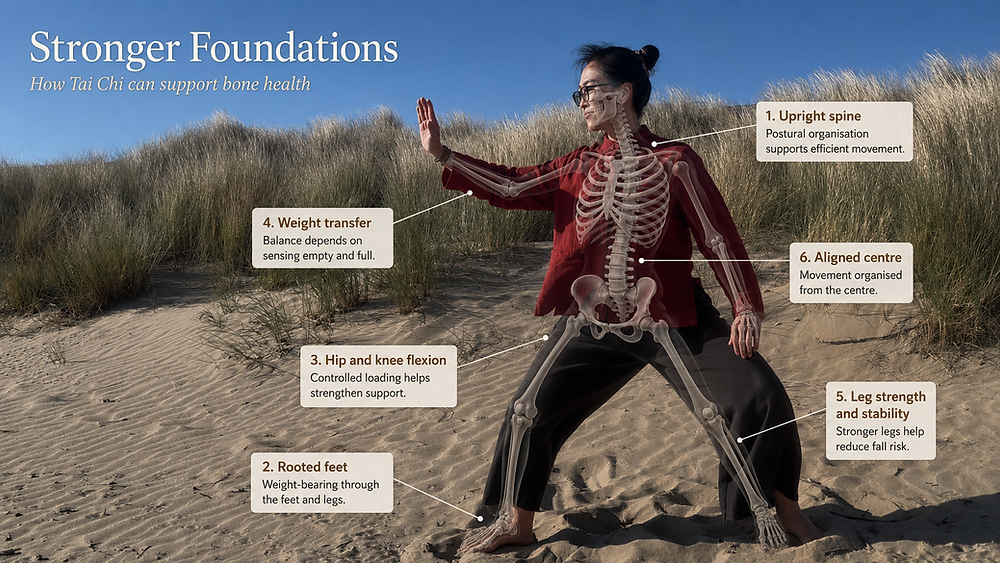
Tai Chi can contribute to this broader approach because it is usually practised while standing and repeatedly asks the body to support, transfer and control its own weight.
Its effect, however, depends upon how it is performed. Slowly moving the arms while the legs remain largely inactive will create little physical demand. More substantial practice involves the whole body: maintaining an upright posture, bending the knees appropriately, shifting the centre of gravity and stepping with control.
Developing strength through controlled movement
In Tai Chi, the legs are not merely carrying the upper body around while the hands perform elegant shapes. They are central to the practice.
When we rise and sink, hold a stance or transfer weight from one leg to the other, the muscles around the feet, ankles, thighs, hips and trunk must work against gravity. Repeating these actions can develop muscular endurance and improve the body’s ability to support itself.
Practices such as Wuji standing, Tai Chi walking, Cloud Hands, Brush Knee and Twist Step, and supported single-leg work can be used to develop:
stronger legs and hips
more stable ankles
controlled knee bending
clearer weight distribution
greater postural endurance
This does not mean Tai Chi produces the same stimulus as progressively lifting heavier weights. The Royal Osteoporosis Society’s strength-exercise guidance explains that strengthening the bones generally requires muscles to work against gradually increasing resistance.
For many adults, particularly from midlife onwards, Tai Chi is therefore best combined with suitable resistance training rather than treated as a complete substitute for it.
What Tai Chi adds is the integration of strength with coordination, posture and movement awareness.
Relaxation does not mean weakness
One of the most frequently misunderstood principles in Tai Chi is sōng, often translated as relaxation or release.
Sōng does not mean becoming limp or removing all muscular effort. It means letting go of unnecessary tension while retaining the organised strength needed to support the body.
When excessive tension is reduced, the bones and muscles can carry weight more efficiently. The knees do not need to be rigid, the shoulders do not need to be lifted and the spine does not need to be forced into an artificial position.
The intention is not to collapse into the joints. It is to discover how the body can remain supported without becoming stiff.
This gives us a useful working principle:
Soften what is unnecessary. Strengthen what supports you.
Balance and the prevention of falls
The strongest scientific evidence for Tai Chi relates to balance and fall prevention.
A 2023 systematic review and meta-analysis of 24 randomised controlled trials found that Tai Chi reduced fall risk among older adults and improved measures of balance, mobility, reach and walking ability.
A later systematic review comparing different types of Tai Chi also found evidence that certain Tai Chi programmes reduced falls among older adults.
This matters because low bone density becomes particularly dangerous when combined with poor balance. Preventing every fall is impossible, but improving the body’s ability to recognise and respond to instability can reduce risk.
Tai Chi repeatedly trains the practitioner to:
distinguish between the weighted and unweighted leg
stabilise before stepping
control changes of direction
transfer weight without rushing
recover during transitions
remain attentive to the feet and surrounding space
Balance is not simply the ability to stand still on one leg. It is the continuing process of sensing change and reorganising the body before control is lost.
The Royal Osteoporosis Society’s balance guidance specifically identifies Tai Chi as an activity that can contribute to a regular balance routine. It also recommends using stable support when necessary and building difficulty gradually.
Restoring confidence in movement
Fear of falling can itself become physically limiting.
When people lose confidence, they may walk less, avoid uneven surfaces or begin taking very short and hesitant steps. This reduces the opportunities to maintain leg strength and practise balance. Over time, less movement can produce even greater weakness and uncertainty.
Tai Chi offers a controlled environment in which people can explore movement without being rushed.
They can practise placing the foot carefully, completing the weight transfer before stepping and using a chair or wall for support where needed. As these actions become more familiar, movement can begin to feel manageable rather than threatening.
This does not require dramatic postures or deep stances. The practice can be adapted to the person while still retaining its essential principles.
Confidence grows not from being told that the body is safe, but from repeatedly experiencing that it can respond.
Supporting posture and spinal organisation
Changes in bone strength can affect the spine, posture and the ability to remain comfortably upright.
Tai Chi and Qigong cannot reverse a spinal fracture or restore lost bone by correcting posture. They can, however, help people become more aware of how the head, ribcage, pelvis and legs are organised.
A traditional Tai Chi principle known as xū líng dǐng jìn encourages a light sense of upward extension through the crown of the head. This is not achieved by pulling the shoulders back or forcing the spine straight. The body rises without becoming rigid.
Careful standing and moving practice can develop:
awareness of habitual collapsing or bracing
endurance in the muscles supporting the spine
a clearer relationship between the ribs and pelvis
easier breathing
more efficient distribution of weight
Good posture is not a single perfect position. It is the ability to remain organised while standing, reaching, turning and walking.
That is especially relevant because many falls occur during transitions rather than while someone is standing perfectly still.
Does Tai Chi improve bone density?
The evidence that Tai Chi directly improves bone mineral density is encouraging, but it is not completely consistent.
A 2021 systematic review and meta-analysis examined 23 randomised controlled trials. It found improvements in bone mineral density at several skeletal sites when Tai Chi was compared with no exercise. However, Tai Chi did not produce a clear additional benefit when compared with other forms of exercise.
A more recent 2026 systematic review of adults with osteoporosis or osteopenia reported improvements at the lumbar spine, hip and femoral neck following regular Tai Chi practice. The authors nevertheless acknowledged that previous findings had been inconsistent.
Other research has been more cautious. A systematic review focusing on postmenopausal women did not find a significant improvement at the lumbar spine or femoral neck.
It would therefore be misleading to promise that Tai Chi alone will rebuild weakened bones.
A more responsible conclusion is that standing Tai Chi may help slow bone loss in some groups, particularly when compared with inactivity. Its effects on bone density are less certain when compared with more demanding strength or impact exercise.
Its more firmly established contribution is the combination of controlled weight-bearing movement, improved balance, leg strength and greater confidence.
Where Qigong fits
Qigong includes many different kinds of practice.
Some forms involve standing, sustained postures, knee bending and repeated rising and sinking. These may place useful demands on the muscles and skeleton.
Other forms are primarily seated or focus on quiet breathing and very light movement. These are unlikely to provide enough resistance to improve bone strength directly.
Their value lies elsewhere.
Quieter Qigong can help people:
notice how they are holding their bodies
reduce excessive muscular tension
reconnect breathing with movement
establish a regular practice routine
settle before sleep
approach physical activity with less anxiety
A practice does not need to be physically demanding to be valuable, but its benefits should be described accurately.
Qigong may support recovery, body awareness and consistency. It should not be presented as an invisible substitute for the physical loading that bones require. Apparently Qi has enough responsibilities without also being appointed as a supernatural building contractor.
The bones as our deeper foundation
In traditional Chinese thought, the bones are closely associated with Jing, our deeper constitutional foundation.
This traditional understanding is not the same as a scientific explanation of bone metabolism. It offers a complementary way of thinking about structure, ageing and the preservation of vitality.
The bones allow us to stand, bear weight and move through life. Tai Chi asks us to become more conscious of that foundation: rooted through the feet, supported by the legs, organised through the centre and gently lifted through the spine.
From this perspective, caring for our bones is not only about avoiding disease. It is about preserving the capacity to remain upright, adaptable and independent.
Building a complete bone-health approach
Tai Chi and Qigong can make a meaningful contribution to bone health, but they should sit within a complete and realistic approach.
This may include:
progressive resistance training
appropriate weight-bearing or impact activity
sufficient dietary protein, calcium and vitamin D
balance training
medical assessment where risk factors are present
osteoporosis medication when clinically recommended
consistent Tai Chi or Qigong practice
Exercise is valuable, but the Royal Osteoporosis Society advises that it should not replace prescribed osteoporosis medication for people at high risk of fractures.
Anyone with diagnosed osteoporosis, previous spinal fractures, multiple fractures, recent injury or significant balance problems should seek guidance from a doctor or physiotherapist before beginning a new exercise programme.
Most people with osteoporosis can remain active, but the movements, intensity and range may need to be adapted.
Stronger foundations
Tai Chi is not a magical shield against ageing, and Qigong cannot remove every physical risk.
What these practices can offer is a way to build a more intelligent relationship with the body.
They teach us to recognise where our weight is placed, strengthen the legs that support us, organise the spine without rigidity and respond more effectively when balance changes.
Strong bones matter. So does the body’s ability to use them well.
This is the intention behind Stronger Foundations: not to resist ageing through force, but to cultivate the strength, awareness and adaptability that allow us to meet it well.
Where attention goes, Qi follows.
Be well & Remain Curious,
Dr Jar
Disclaimer: This article is for general information and does not replace individual medical advice.
References
UK Chief Medical Officers’ Physical Activity Guidelines
UK physical activity guidance for adults and older adults
Royal Osteoporosis Society: Exercise for Bones
Royal Osteoporosis Society: Strength Exercise for Bone Health
Royal Osteoporosis Society: Exercise to Improve Balance
Tai Chi for Fall Prevention and Balance Improvement in Older Adults
Effects of Different Types of Tai Chi on Preventing Falls
Tai Chi Training Duration, Frequency and Bone Mineral Density
Tai Chi, Osteoporosis and Osteopenia in Middle-Aged and Older Adults
Tai Chi and Bone Mineral Density in Postmenopausal Women
Responses
Share a reflection with Dr Jar.
Your message is reviewed before anything is published, helping keep this a thoughtful and respectful space.