
Insights & Practice
Move as One: When the Body and Mind Have Drifted Apart
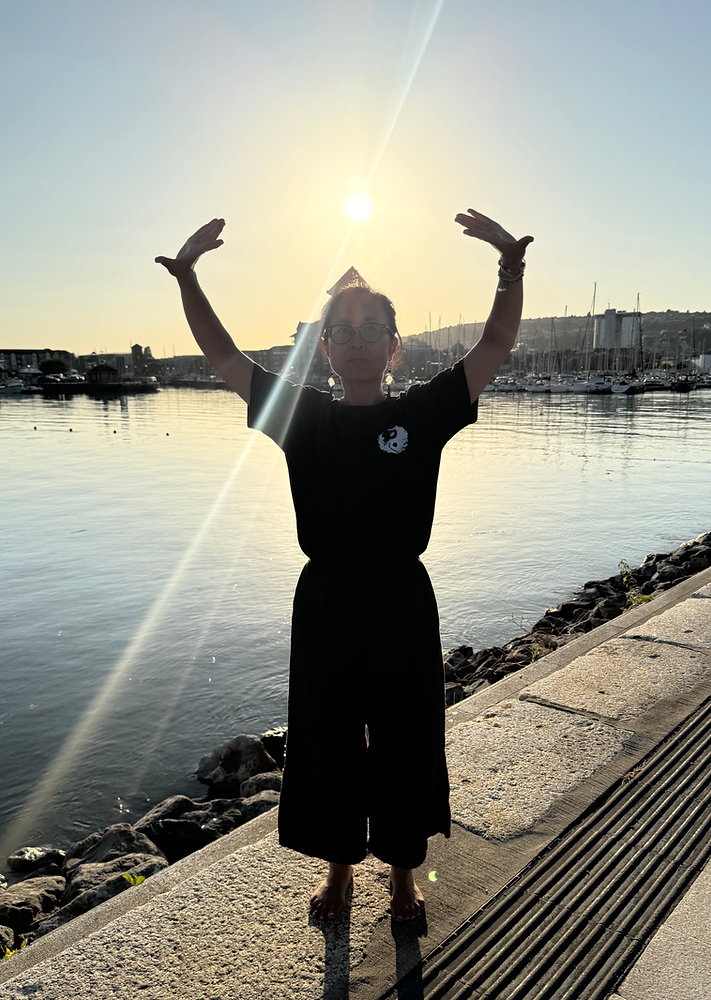
There are different ways to lose touch with yourself.
For one person, the day is relentless.
Messages. Work. Appointments. Family. Traffic. Decisions. Responsibilities.
They arrive home at the end of the day and finally sit down, but something strange happens.
The body has stopped, but they have not.
The shoulders are still slightly raised. The jaw has not quite let go. The breathing is happening somewhere high in the chest. Part of the mind is replaying something from earlier while another part is already organising tomorrow.
They tell themselves to relax. Nothing much happens.
But there is another person whose day looks completely different.
They have been home for most of it.
There may be nowhere particular they need to be and nobody expecting them at a particular time.
The television goes on in the morning and stays on, sometimes because there is something to watch and sometimes simply because a quiet house feels even quieter without it.
They sit for longer than they intended.
Perhaps they wander into the kitchen.
Not necessarily because they are physically hungry.
Food might offer comfort, stimulation or simply something to punctuate another long stretch of the day.
Then comes the familiar promise: Tomorrow I’ll do something different.
But tomorrow can look remarkably like today.
These two lives appear almost opposite.
One contains too much.
The other can feel as though it contains far too little.
Yet there is something they can share:
the experience of becoming disconnected from the body, from the present moment and sometimes from ourselves.
This week at Apex Tai Chi, we have been exploring what happens when we begin to come back.
We tend to think of our mental state as something happening primarily inside our heads.
If the mind is busy, we try to think differently.
If we feel unsettled, we tell ourselves to calm down.
If motivation disappears, we try to talk ourselves into doing something.
If we feel lonely, we might distract ourselves.
Sometimes those strategies help.
But there is another direction we can explore.
What if we begin with the body?
The brain is continually receiving information from the body. One part of this relationship is described through interoception, our perception and interpretation of signals arising from within the body.
Breathing, heartbeat, muscular tension and other internal sensations contribute to our moment-to-moment experience.
Research into interoception has increasingly explored its relationship with emotional experience and emotion regulation.
But Tai Chi introduces another fascinating dimension.
It asks us not only to notice the body.
It asks us to notice how the body is organised.
And that can reveal quite a lot.
Sometimes the body tells the story first
Spend a moment noticing yourself now.
Where are your shoulders?
What is happening around your jaw?
Can you feel your feet?
When did you last stand up?
How deeply are you breathing?
Is your body comfortable or simply accustomed to the position it has been occupying?
You do not need to change anything immediately… Just notice.
Because sometimes the body tells us something before we have found words for it.
A person can say, “I’m fine,” while holding their shoulders somewhere near their ears.
Another can say, “I really should get out more,” while remaining in the same chair for another afternoon.
Another may realise that they have spent most of the day responding to screens, demands and other people’s needs without noticing themselves at all.
This is not about judgement. It is about awareness. And awareness gives us somewhere to begin.
There is one experience I particularly want to acknowledge.
Not everybody comes to Tai Chi because life is too busy.
Sometimes people come because life has become too quiet.
Loneliness can have a physical quality.
It can be felt in long hours spent in one room, in the heaviness of getting out of a chair, in days without meaningful conversation, or simply in reaching the evening and realising how little you have moved.
Food can sometimes become part of that pattern too.
Eating can offer comfort, stimulation, distraction or something to look forward to when very little else seems to be happening.
I don’t think experiences like loneliness, isolation or binge eating should be reduced to simplistic advice.
And Tai Chi should not be presented as a magical cure for them.
But movement can provide something much smaller and more immediate.
A point of return.
Stand up.
Feel your feet.
Let the shoulders move.
Allow the spine to turn.
Shift your weight.
Notice your breathing.
For a few minutes, instead of watching the world from a chair or becoming absorbed in thoughts about what you should or should not be doing, you are participating in your own body again.
Sometimes the beginning does not need to be bigger than that.
Something interesting happens when people first learn Tai Chi. Naturally, they want to get it right.
They watch their hands.
They remember where the foot goes.
They try to turn the waist.
They wonder whether the arm is high enough.
They attempt to remember the next movement.
Suddenly, one Tai Chi movement has become six separate jobs.
The hands are doing one thing.
The shoulders have volunteered for several tasks nobody gave them.
The legs are doing something underneath.
The breathing has quietly disappeared.
And the mind is attempting to supervise the entire operation.
Then we change something.
Instead of worrying about the hands, I might ask:
Can you feel your feet?
The person settles.
The weight becomes clearer.
The shoulders soften.
The waist begins to turn.
The arms stop manufacturing the movement and begin responding to what the rest of the body is doing.
Suddenly, there is less effort.
But there is more movement.
There is less control.
But there is more coordination.
And often there is more presence.
That is where today’s practice begins.
Today we are exploring three simple elements:
Wuji → Hold the Ball → Parting Wild Horse’s Mane
You do not need to know a complete Tai Chi form.
You do not need to be flexible.
And you certainly do not need to reproduce those beautiful photographs of somebody practising beside a Chinese lake at sunrise while mist floats obligingly through the mountains.
A living room will do.
So will a community hall.
So will wherever you happen to be standing.
The important thing is to notice.
1. Wuji: arrive before you move
Stand comfortably.
Allow your feet to meet the ground.
Before correcting your posture, simply notice it.
Where is your weight?
Are you leaning forwards?
Are the knees locked?
Are the shoulders working unnecessarily?
Is the abdomen being held?
Can you allow yourself to do slightly less?
In Tai Chi, Wuji is not simply waiting for the exercise to begin.
It is already part of the practice.
It is a moment of arriving.
Let the feet receive the ground.
Allow the knees to remain easy rather than rigid.
Let unnecessary tension around the hips, shoulders and chest begin to soften.
Do not force the breathing.
Simply allow yourself to notice it.
Then recognise something extraordinarily ordinary:
You are here.
Not in tomorrow.
Not in yesterday’s conversation.
Not inside the television.
Not inside your phone.
Here.
For somebody who spends much of the day mentally racing ahead, this matters.
For somebody whose days have become repetitive and disconnected, it matters too.
You are not asking yourself to transform your life.
You are simply beginning by inhabiting this moment.
From Wuji, begin to form Hold the Ball.
One arm rounds above.
The other rounds below.
There is space between the arms.
But instead of becoming preoccupied with the exact position of your hands, notice what supports them.
Feel your feet.
Feel your legs.
Notice your centre.
Allow the shoulders to remain relatively easy.
The hands are not separate objects floating at the end of your arms.
They belong to everything underneath them.
This is where Tai Chi starts becoming much more interesting than choreography.
We begin to move away from controlling individual parts and towards experiencing relationship between the parts.
Research into Tai Chi has examined aspects of proprioception and sensorimotor processing, the systems through which we perceive and coordinate the position and movement of our bodies.
But you do not need specialist terminology to begin exploring the experience.
You can feel it.
When the shoulders take over, the movement feels one way.
When the whole body supports the movement, it feels another.
Tai Chi asks us to become curious about that difference.
From Hold the Ball, begin Parting Wild Horse’s Mane.
There is a temptation to lead everything with the hands.
Wait.
Feel the change underneath first.
Allow the weight to begin transferring.
Feel the foot connect with the ground.
Let the body organise around that change.
Allow the waist and centre to guide the direction.
Then let the arms express the movement.
This sounds simple.
It can take years to understand deeply.
But even as a beginner, you can begin to recognise the difference between:
moving an arm
and
allowing the arm to belong to the movement.
If the shoulders become tense, soften.
If the hands rush ahead, wait.
If you lose awareness of the feet, return to them.
And if everything becomes muddled?
Good… You noticed.
That moment of noticing is part of the practice.
There is a wider lesson here.
When life becomes difficult, our instinct is often to add effort.
Work harder.
Concentrate harder.
Try harder to relax.
Try harder to stop eating.
Try harder to motivate yourself.
Try harder not to feel lonely.
Try harder to sleep.
Try harder to stop thinking.
But constantly fighting ourselves can become another form of exhaustion.
Tai Chi offers a different question:
What happens if I organise myself differently?
Feel the ground.
Let the weight settle.
Release some unnecessary effort.
Allow one part of the body to stop fighting another.
Bring attention back to what is actually happening.
Then move.
Slowly.
The purpose is not to escape your life.
It is to become a little more present within it.
You do not need an hour.
If you have been sitting for a long time, stand up.
Begin in Wuji.
For a few breaths, notice your feet, your weight and anywhere you are using more effort than necessary.
Then form Hold the Ball.
Rather than concentrating entirely on the hands, notice the relationship between the feet, legs, centre, torso and arms.
Slowly move into Parting Wild Horse’s Mane.
Let the weight change.
Allow the centre to guide.
Let the arms follow.
Return.
Then repeat.
Do not ask:
“Am I doing this perfectly?”
Ask:
“Can I feel more of myself here?”
And then:
“Can I feel more of myself moving together?”
That is enough.
Return to the two people we met at the beginning.
The first arrives home after a relentless day.
The body has stopped, but the mind is still running.
Instead of immediately collapsing into another screen, they stand.
Feet.
Breath.
Weight.
Hold the Ball.
One step.
One turn.
Parting Wild Horse’s Mane.
Nothing dramatic happens.
Tomorrow still contains responsibilities. But for several minutes, body and attention occupy the same place again.
Now think about the second person.
The television has been on for hours.
The afternoon has drifted into evening.
The familiar urge arises to walk into the kitchen again.
But this time, something interrupts the pattern.
They stand.
Perhaps reluctantly.
They feel their feet.
The shoulders move.
The spine turns.
The weight travels from one leg towards the other.
For three minutes, they are not simply watching something happen.
They are doing something.
Neither person’s life has magically changed.
And that matters.
Because meaningful change is not always dramatic.
Sometimes it begins with a very small interruption to an old pattern.
Stand.
Feel.
Move.
Notice.
Return.
And perhaps tomorrow, do it again.
There is another part of wellbeing that cannot be recreated entirely at home.
Other people.
Practising alone can be valuable. But practising alongside others gives us something different.
There is somewhere to go.
Someone says hello.
You begin recognising familiar faces.
You move together.
Perhaps you talk before the session begins.
Perhaps somebody smiles at you afterwards.
Nobody needs you to perform.
Nobody needs you to explain why you came.
You simply share an hour of practice with other human beings.
For somebody whose life is extremely busy, that hour can become protected space away from demands.
For somebody who has become isolated, it can become something equally valuable: a reason to leave the house.
For an hour, there is somewhere to be.
There are people around you.
There is a body to move.
There is something to learn.
And next week, there is somewhere to come back to.
When somebody has been isolated for a long time, things that appear small from the outside are not necessarily small at all.
You do not need to arrive at Tai Chi feeling flexible.
You do not need to be fit.
You do not need to understand Tai Chi.
And you certainly do not need to arrive feeling calm, confident or sociable.
You can arrive exactly as you are.
Perhaps life has become relentlessly busy and you need somewhere to slow down.
Perhaps your world has become smaller.
Perhaps you have been spending too much time sitting at home.
Perhaps you miss being around people.
Or perhaps nothing is particularly wrong at all.
You simply know that you would like to move more, feel better in your body and experience a different pace for an hour.
You don’t have to explain yourself when you arrive.
You can simply come and practise.
And that might be enough for today.
Join me today in Swansea on Thurday’s
There are two opportunities to practise with Apex Tai Chi at Swansea Wellbeing Centre every Thursday:
4:30-5:30 pm - The Way of Stillness and Flow - Women only
A quieter exploration of Tai Chi and Qigong through movement, stillness and embodied awareness.
7:00-8:00 pm - Authentic Tai Chi: The Present Moment
An exploration of authentic Tai Chi principles through movement, coordination and present-moment practice.
£5 per session, payment at the venue.
Beginners are welcome.
Booking is encouraged and appreciated.
View today’s sessions and reserve your place
/classes/
You can also explore more Tai Chi and Qigong practices with Apex Tai Chi:
https://www.youtube.com/@Apex-Tai-Chi
Further reading
- Interoceptive Ability and Emotion Regulation in Mind-Body InterventionsAn integrative review exploring interoception, awareness of internal bodily signals and its relationship with emotion regulation in mind-body interventions.
https://pmc.ncbi.nlm.nih.gov/articles/PMC11591285/
- Tai Chi and Sensorimotor ProcessingResearch published in Frontiers in Human Neuroscience exploring Tai Chi practice in relation to sensorimotor processing and coordinated muscular activity.
https://www.frontiersin.org/journals/human-neuroscience/articles/10.3389/fnhum.2016.00037/full
- Effects of Tai Chi and Qigong on Cognitive and Physical Functions in Older AdultsA systematic review and meta-regression of randomised controlled trials examining physical and cognitive outcomes associated with Tai Chi and Qigong practice.
https://pubmed.ncbi.nlm.nih.gov/37280512/
Be well & remain curious,
Dr Jar
Apex Tai Chi
Authentic Tai Chi & Qigong for modern wellbeing
Responses
Share a reflection with Dr Jar.
Your message is reviewed before anything is published, helping keep this a thoughtful and respectful space.