
Insights & Practice
Awaken the Connection: Reclaim Your Power, Reclaim Your Life
Apex Tai Chi: Dr Jar - Swansea, South wales & online
There is a particular kind of absence that can hide inside a very full life.
The diary is busy. Messages are answered. Responsibilities are met. From the outside, everything appears organised. Yet inwardly, there can be a quiet sense of distance, as though life is continuing at speed while some essential part of you has fallen a few steps behind.
You may notice it in small ways. A conversation ends and you realise you were only partly present. A meal is finished without being tasted. You reach the end of the day exhausted, not only because of what you have done, but because your attention has been scattered across too many places at once.
This is not always simple tiredness. Sometimes it is the feeling of living without fully inhabiting your own experience.
The instinctive response is often to search for a solution: a new routine, a better system, another technique for becoming calmer or more focused. Yet the deeper problem is rarely that we lack knowledge.
Most of us already know that rest matters. We understand the value of movement, nourishment and time away from constant stimulation. We recognise the importance of presence, yet still find ourselves distracted in the moments we most want to remember.
The difficulty lies in the distance between what we know and what we repeatedly do.
We know the body needs recovery, then ask it to continue. We value meaningful connection, then carry half our attention elsewhere. We want greater steadiness, yet live according to patterns of urgency.
Over time, that contradiction becomes exhausting. The mind may understand one thing while the body continues to live another.
Tai Chi enters precisely here, not as another task to add to an already crowded life, but as a way of bringing understanding back into the body.
The Connection Is Still There
When people say they feel disconnected, it can sound as though something fundamental has disappeared.
But the relationships that sustain us are still active.
The ground continues to support every step. The breath continues to move between the body and the world. Light influences alertness. Sound changes attention. The presence of another person can alter our breathing before a word has been exchanged.
The body remains in relationship with life, even when our awareness has drifted elsewhere.
What has weakened is not connection itself. It is our ability to feel it.
That distinction matters because it changes the direction of practice. We are not trying to manufacture a special state or become someone new. We are recovering a capacity that already belongs to us.
The return can begin with something very ordinary: the pressure beneath the feet, the rise and fall of the breath, the sensation of weight moving through the body.
These moments may seem small, but they interrupt the habits of automatic living. They bring attention back into direct contact with experience.
What Tai Chi Reveals About Power
Tai Chi offers a clear physical model of what connection means.
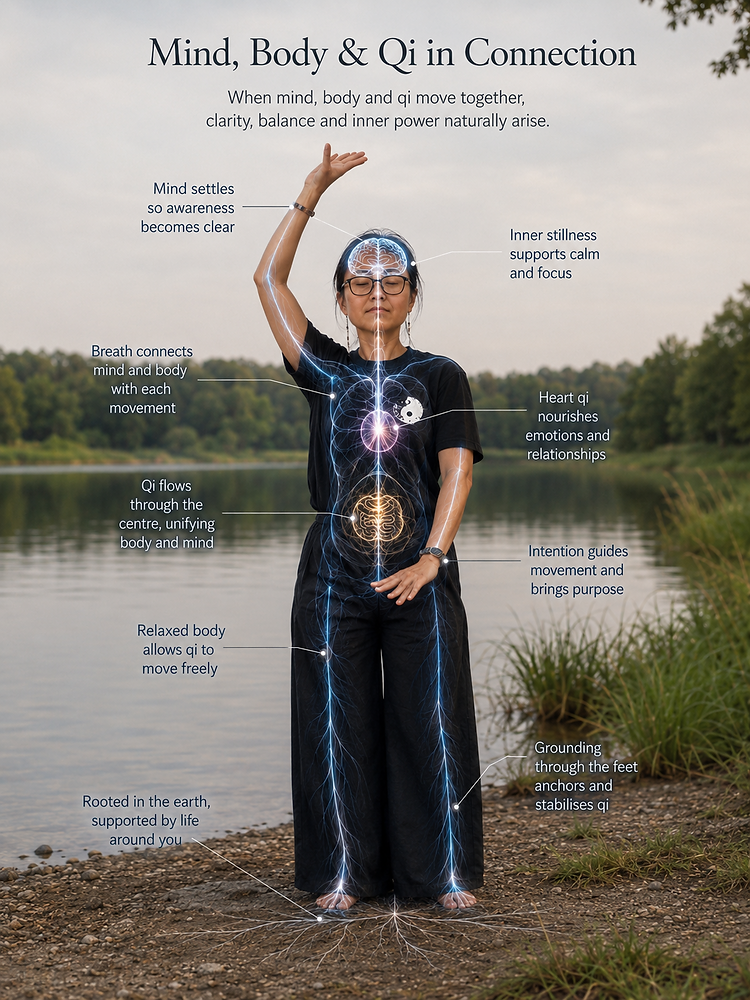
In skilled movement, no part of the body works alone. The feet receive the ground. The legs organise the weight. The waist determines direction. The spine carries the movement through the body. The hands express what has already been coordinated beneath them.
The visible action may appear in the arms, but its quality depends on the whole structure.
This is why force created by one isolated part often feels strained, while a smaller movement supported by the entire body can feel stable and powerful.
The same principle applies to how we live.
Individuality and connection are not opposites. A foot does not lose its role because it supports the hand. The hand does not become less distinct because it follows the movement of the centre. Each part becomes more effective through relationship.
Healthy connection in a family, workplace or community works in a similar way. It does not ask us to disappear into the needs of others. Nor does it require isolation in order to preserve a sense of self.
We become more capable when we can remain grounded in who we are while participating in something larger.
Power, in this sense, is not domination. It is coherence.
Why Constant Effort Eventually Weakens Us
Many people have become highly practised at effort.
We know how to push through tiredness, hold ourselves together and continue despite discomfort. These qualities can be useful. The problem begins when effort becomes the only mode we trust.
A body held in constant tension eventually loses responsiveness. A mind kept permanently alert struggles to settle. Even determination becomes less effective when there is no rhythm of recovery around it.
Tai Chi teaches through cycles.
The body rises and then sinks. It opens and then closes. Weight gathers in one leg before passing into the other. One movement develops from the completion of the previous one.
Release is not the opposite of strength. It is part of how strength renews itself.
Without emptying, there can be no next step. Without exhalation, there can be no fresh breath. Without a moment of settling, movement becomes rushed and disconnected.
This is yin and yang experienced through the body.
Strength without softness becomes rigid. Softness without structure loses direction. Real capability lives in the movement between the two.
The same rhythm is needed in daily life. There are moments for determination, boundaries and clear action. There are others for listening, recovery and allowing a response to form before acting.
Wisdom is not found in choosing effort or release once and for all. It lies in knowing how to move between them.
The Body Notices Before the Mind Explains
The body is continually receiving information from its surroundings.
A room may feel tense before you consciously understand why. A familiar voice may soften your breathing. Harsh light may increase restlessness. A crowded environment can make the body contract before you have formed a thought about it.
These responses are sometimes dismissed as oversensitivity. Yet they are part of the body’s intelligence.
The difficulty is not that we notice too much. It is that we often fail to recognise what the body has already noticed.
Tai Chi develops a wider and steadier form of attention. During practice, awareness includes the feet, the changing weight, the breath, the direction of movement and the space around the body. None of these needs to dominate.
We learn to remain receptive without becoming overwhelmed.
This has consequences beyond the training space. We may notice tension before it hardens into pain. We may recognise that a conversation is unsettled before reacting impulsively. We may become more aware of which environments restore us and which continually demand more than they give.
Sensitivity, when supported by grounding, becomes discernment.
When Pain or Fear Fills the Whole Field
Pain and fear have a way of taking over the scale of experience.
Pain can begin to feel like the whole body. Fear can begin to feel like the whole future. A difficult period can become so dominant that everything else seems to disappear behind it.
The practice is not always to make the difficulty vanish.
Sometimes the more realistic task is to widen the field around it.
There may be pain, but there is also contact beneath the feet. There may be fear, but the breath is still moving. One part of the body may feel guarded while another remains warm, supported or at ease.
This does not minimise suffering. It restores proportion.
The problem remains real, but it is no longer permitted to define the whole of life.
Meaningful change does not always arrive as the complete absence of struggle. It may appear as the return of enough space, support and possibility that struggle no longer dictates every decision.
A larger life can hold difficulty without becoming identical to it.
Leaving Autopilot
Autopilot rarely announces itself dramatically.
It appears in the meal eaten while reading messages, the journey completed without being remembered, the conversation in which the body is present but the attention is already elsewhere.
Because it develops through repetition, reconnection must also be repeated.
Before standing, feel the feet.
Before answering, notice the breath.
Before beginning the next task, allow the previous one to finish in the body.
These small pauses restore continuity between awareness and action.
Tai Chi gives us a place to practise this deliberately. We learn to settle before moving, to let the centre organise before the arms act, and to arrive fully before changing direction.
Over time, the lesson begins to follow us into daily life.
We become less likely to react from tension we have not noticed. There is more room between stimulus and response. We can act with greater clarity because we are not trying to move from ten different places at once.
Calm and balance may emerge, but they are not objects to chase. They are consequences of a life becoming less divided.
Reclaiming Power Through Participation
The word power is often associated with force, control or the ability to impose an outcome.
Tai Chi offers another understanding.
Power is the capacity to remain connected enough to respond well.
It is the ability to feel support when circumstances are uncertain, to release unnecessary tension without losing direction, and to stay open to information without being swept away by it.
This form of power is quieter, but it is not passive. It allows us to act without scattering ourselves. It helps us contribute without disappearing. It gives difficulty a place without allowing difficulty to become the whole story.
Nothing essential has been lost.
The body still knows how to breathe. The ground has not withdrawn its support. The capacity to listen, organise and return remains present, even after long periods of living at a distance from ourselves.
The return does not need to be dramatic.
It begins through the decision to participate more fully.
One breath.
One step.
One movement.
Life is already in relationship with you. The invitation is to notice that relationship and enter it again with attention.
That is where real change begins.
Continue the Practice
My free Authentic 7-Day Detox Reset offers a practical way to reduce physical and mental overload through Tai Chi-inspired movement, nourishment guidance and daily reflection. It is designed to help you release what has become excessive and restore a steadier relationship with your body, attention and daily energy.
- Begin your free Authentic 7-Day Detox Reset
https://apex-tai-chi-7-day-detox-reset.netlify.app/#get-guide
- Watch the companion video: Awaken the Connection
- Join the Apex Tai Chi Insights & Movement Newsletter
/newsletter/
- Explore Apex Tai Chi classes, one-to-one sessions and practice guidance
/
- For enquiries
Remember: where focus goes, qi flows.
Apex Tai Chi
Authentic Tai Chi, Qigong & Daoist Movement for modern wellbeing.
Be well & remain curious,
Dr Jar
Responses
Share a reflection with Dr Jar.
Your message is reviewed before anything is published, helping keep this a thoughtful and respectful space.