
Insights & Practice
Ancient Principles for a Stronger Foundation
Dr Jar - Apex Tai Chi - Swansea, South Wales & online
There is a particular kind of tiredness that has nothing to do with sleep. It shows up as a low hum of tension in the shoulders, a slight bracing in the jaw, a body that feels like it is always working just to stay upright. If you have felt this, you already sense something modern research is only beginning to confirm: how you organise your body under gravity shapes far more than how you move. It shapes how strong you become, and how well that strength holds as you age.
Osteoporosis, joint wear, and declining balance are usually framed as problems of the bones themselves, as though bones existed in isolation, quietly weakening on their own schedule. Tai Chi has never seen it this way. The bones are not a separate system to be treated. They are one expression of how the whole body organises itself: through posture, movement, and a continuous relationship with gravity. The old masters were never really asking “how do we protect the bones?” They were asking how the human body should stand, move, and carry itself under the weight of the world. That question turns out to matter a great deal for bone health.
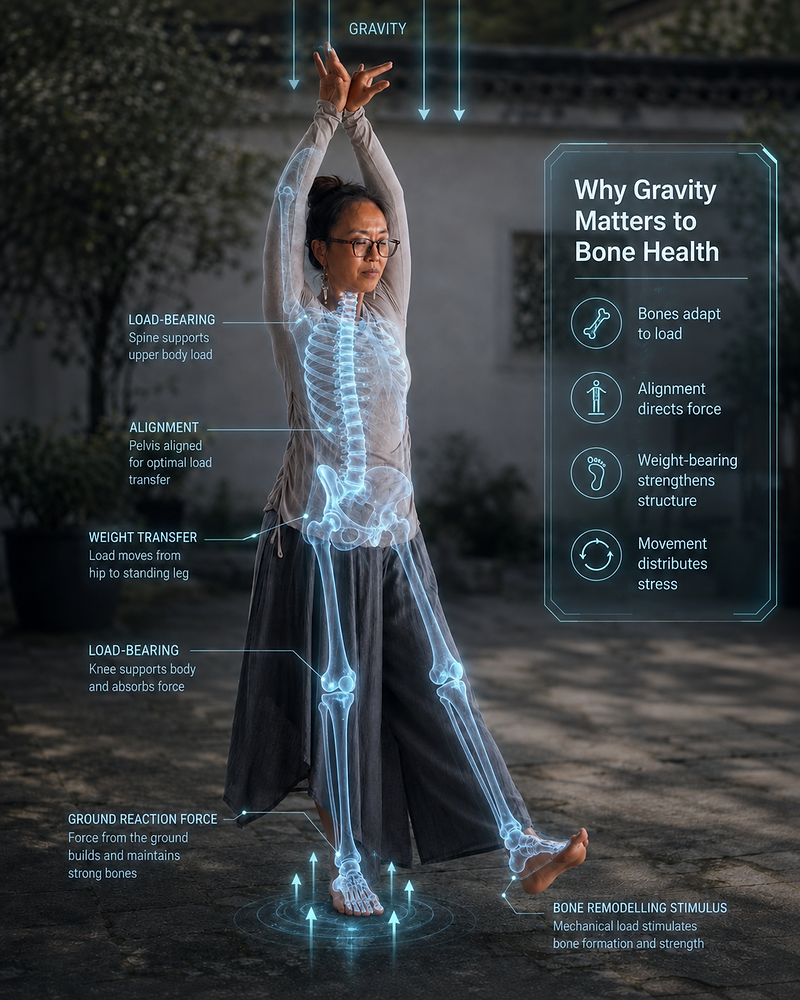
Bones are living tissue, and living tissue responds to demand. When loaded, asked to bear weight, resist force, absorb impact, bone adapts by becoming denser and more resilient. This is well established. What is less often discussed is that how the load arrives matters as much as how much of it there is.
Poorly organised loading concentrates force in the wrong places: a locked knee, a collapsed arch, a spine that braces instead of aligns. Well-organised loading distributes force through the feet, legs, pelvis, and spine, sharing the demand across the whole structure rather than dumping it on any single joint, with muscles and connective tissue acting as a network that transmits weight intelligently.
Tai Chi, practised correctly, is exactly this: low-impact, deliberately organised, weight-bearing movement. It does not overload the body. It teaches the body to carry its own weight well, a different, and in many ways more valuable, skill.
Five Tai Chi Principles for a Stronger Foundation
The Tai Chi classics were written centuries before anyone measured bone density in a laboratory, yet they describe, with striking precision, the conditions under which a body becomes genuinely resilient. Five principles in particular speak directly to the foundation we build with every step we take.
1. Build a Body That Can Receive Weight
立身须中正安舒,支撑八面。 “Stand upright with central alignment and relaxed ease, capable of supporting in all directions.”
Most people hold themselves upright through effort: gripping, bracing, over-tensing muscles never meant to do this much work alone. Central alignment offers a different option: a body arranged so the skeleton itself can accept weight, rather than muscles fighting to hold it up. This is not passive. It is an active, ongoing relationship with gravity, where standing becomes a skill rather than a default state.
2. Stillness Builds the Foundation; Movement Keeps It Alive
立如平准,活似车轮。 “Stand as steadily as a balanced scale; move as smoothly as a turning wheel.”
Stillness and movement are not opposites in Tai Chi; they complete each other. Standing is where the body’s organisation is established. Movement is where it is tested and refined. This is the principle of xu and shi, empty and substantial: one part of the body bears weight while another remains free. This deliberate shifting gives bones varied loading through weight transfer, rather than the same static stress repeated endlessly.
3. Organising Load Through Movement
迈步如猫行,运劲如抽丝。 “Step like a cat; move force as though drawing silk.”
A cat’s step is controlled and measured: never a fall disguised as a step. In Tai Chi, weight is fully organised on one leg before it is offered to the other. Force moves continuously, like silk being drawn from a cocoon, rather than arriving in sudden jolts. This is what allows the body to avoid concentrating demand in one vulnerable joint, and instead spread the work of bearing weight across the whole structure.
4. Stability Emerges from Relaxation
极柔软,然后极坚刚。 “Only through complete softness can true firmness emerge.”
This is perhaps the most counterintuitive principle, and the most important. Softness here does not mean collapse: it means the absence of unnecessary resistance. A rigid structure is brittle; it has nowhere to go when force arrives. A body that has learned genuine relaxation in its joints and connective tissue can absorb, adapt, and remain stable precisely because it is not fighting itself. Mobility and stability, in this view, are not competing goals. They depend on each other.
5. The Skeleton Functions as One System
一动无有不动,一静无有不静。 “When one part moves, every part moves; when one part becomes still, the whole body becomes still.”
The feet, legs, pelvis, spine, and limbs are not separate departments. They are one coordinated structure, sharing force and sharing responsibility. Healthy bone, from this view, is never the product of an isolated exercise for an isolated joint. It is one expression of a whole body that has learned to organise itself well.
Ancient Wisdom and Modern Movement Science
Set side by side, the language of the Tai Chi classics and the language of contemporary movement science are describing much of the same territory: weight-bearing exercise, dynamic balance, postural control, motor coordination, fall prevention. The vocabularies differ, one speaks of xu and shi, the other of proprioception and load distribution, but the underlying understanding is remarkably aligned. This is not mysticism catching up with science. It is two careful traditions, separated by centuries, arriving at similar conclusions about how the human body thrives.
Can Tai Chi Strengthen Bones?
It’s worth being precise here. Tai Chi is not a treatment for osteoporosis, and it should never replace clinical guidance, medical monitoring, or appropriate resistance training. What it offers is something complementary: regular, well-organised, weight-bearing movement, paired with meaningful improvements in balance and fall risk, which matters enormously, since a fall is often more consequential than the bone density measurement itself. As with any practice, individual adaptation matters. What serves one body well may need adjusting for another.
How to Apply These Principles in Practice
Stand without stiffening. Find central alignment. Let the knees and hips soften rather than lock. Notice, and release, unnecessary tension in the upper body.
Transfer weight clearly. Fully empty one leg before stepping into the next. Avoid falling or leaning into a step: move slowly enough to actually feel the organisation happening.
Let the whole body participate. Allow the pelvis and centre to lead movement, rather than isolating the arms. Maintain continuity through every transition, so nothing moves abruptly on its own.
Practise consistently. Short, regular sessions build this skill far more reliably than occasional long ones. Progress gradually. Prioritise quality of movement over intensity of effort.
Building Resilience Over Time
Healthy ageing is not a single event to prepare for. It is an ongoing process of adaptation. Confidence, balance, and movement quality are deeply linked: as one improves, the others tend to follow. Learning to organise the body well under gravity is, in the end, both a physical skill and a psychological one. A stronger foundation changes how capable you feel, not only how capable you are.
References
Kong, J., Tian, C., & Zhu, L. (2023). Effect of different types of Tai Chi exercise programs on the rate of change in bone mineral density in middle-aged adults at risk of osteoporosis: a randomized controlled trial. Journal of Orthopaedic Surgery and Research, 18(1), 949.
Huang, Z., et al. (2023). Tai Chi for fall prevention and balance improvement in older adults: a systematic review and meta-analysis of randomized controlled trials. Frontiers in Public Health (hosted via PMC).
National Center for Complementary and Integrative Health, National Institutes of Health. Tai Chi: What You Need To Know. NCCIH, NIH.
Effects of Tai Chi on balance and fall prevention in healthy older adults: a randomized controlled meta-analysis (2025). Frontiers in Public Health.
As always, Tai Chi should complement, not replace, guidance from your own healthcare provider, particularly if you have an existing diagnosis such as osteoporosis.
Explore Authentic Tai Chi with Dr Jar
If these principles resonate, the next step is to feel them in your own body. A few ways to continue:
-
Watch: My latest Youtube recording… exploring the themes in this blog, in practical way - https://youtu.be/Aw9MiJrX5hE
-
Explore Private One-to-One Tai Chi Programmes Personalised sessions designed around your body, health, goals, and pace of learning. /private-practice/
-
Join the Apex Tai Chi Insights & Movement Newsletter Receive weekly teaching, home practice guidance, reflections, and class updates. /newsletter/
-
Explore Apex Tai Chi /
✉️ Enquiries: drjar@apextaichi.com
Responses
Share a reflection with Dr Jar.
Your message is reviewed before anything is published, helping keep this a thoughtful and respectful space.